Automotive bold creative campaign
- 6 shots
- Bold creative
- Model included
- Landscape grid
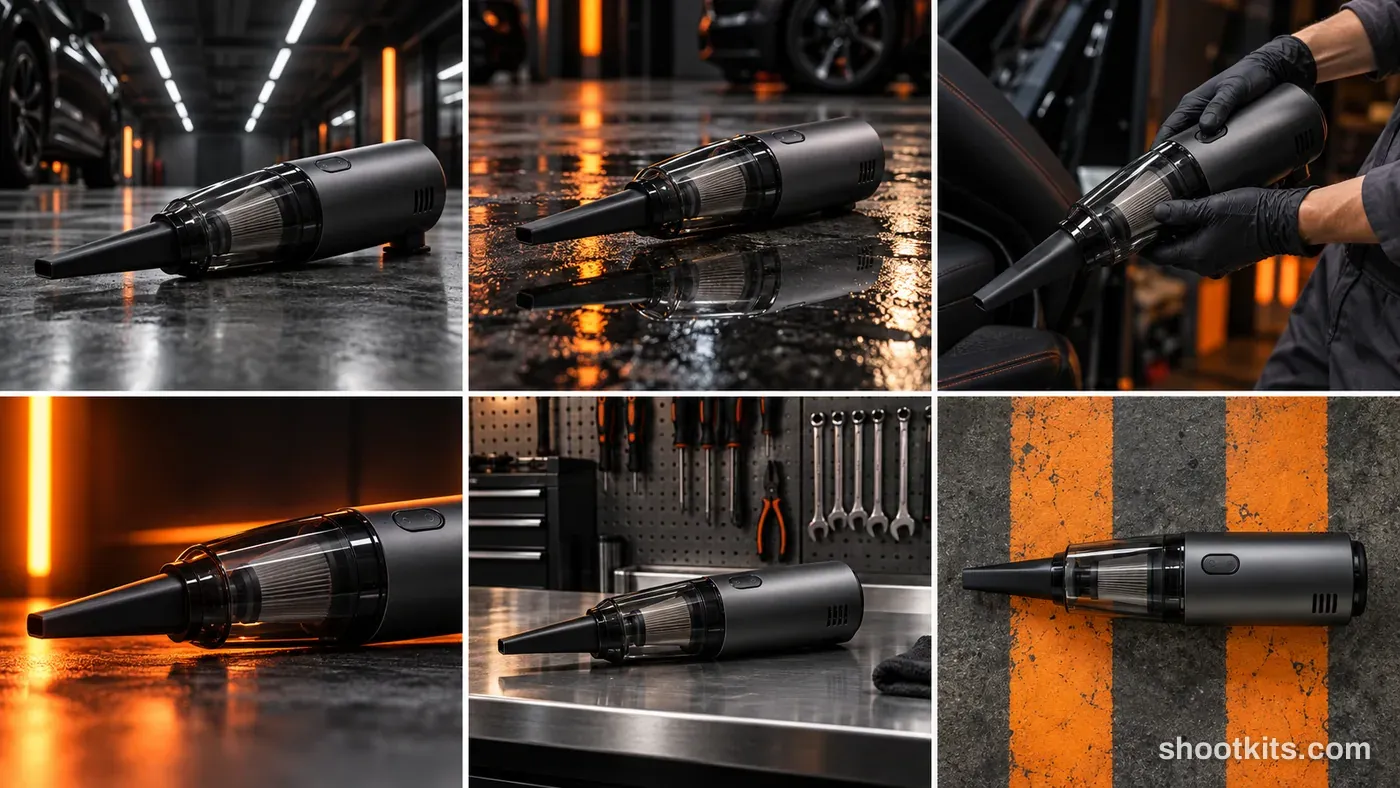
A dark garage, wet reflections and orange light can give an automotive product launch a stronger visual identity. This grid suits portable vacuums, workshop accessories and detailing tools, balancing graphic product views with a practical handling moment. Give ChatGPT a clear photograph of your own item and identify the parts that must remain exact. Let the surroundings supply the drama, then check that reflections and gloves do not conceal the construction customers need to see.
Describe your car product in a few words. Still attach your product photo in ChatGPT.
Attach your product photo before you paste the prompt. A plain background and even light give the most accurate result.
Shot list
Want one shot at full size? Open it and copy its prompt on its own.
R1C1Light-strip heroProduct on a dark reflective floor under parallel strip lights
Create one photorealistic campaign photograph, not a grid. Input: ONLY [PRODUCT REFERENCE / PRODUCT DESCRIPTION]. Campaign route: Bold creative. Creative concept: An original graphic campaign built from road and workshop geometry, with dramatic light and a strong product focus. Example art direction: Dark concrete garage, wet floor reflections, hard strip lights and orange accent light. Example palette: asphalt black, signal orange, chrome. Derive the final colors, casting, styling and set from the supplied product. No separate outfit, model or location input is required. Choose one suitable adult model internally and keep face, hairstyle, skin tone, proportions and supporting styling consistent across this campaign. Casting may differ between campaigns. Any vehicle shown is a generic, unbadged modern car with no readable logos or number plates. Preserve the product reference's exact design, color, material, geometry, construction, size, packaging and visible branding. Inspect the actual product shape, finish, mounting points, nozzles, labels and packaging; never place the product on a recognizable branded vehicle or show readable car badges or number plates. Adapt any shot involving a pump, cap, cuff, sleeve, strap, container, animal or ingredient to what actually exists; do not invent absent features, accessory products, ingredients, performance claims or internal mechanisms. Example colors and materials are creative cues: substitute the supplied product's true characteristics. Keep skin, fur, hands, fabric behavior, scale, physical contacts, reflections and shadows plausible. No captions, panel numbers, invented logos, watermark or screenshot UI. Shot R1C1: Light-strip hero. Action: Product on a dark reflective floor under parallel strip lights. Camera: low front. Framing: product hero. Where a subject is present, reuse the campaign's internally generated hero for face, animal and styling continuity. Product-only framing contains no human or animal. Full-body framing includes complete head and feet; full-animal framing includes complete head, tail and paws.R1C2Wet-floor reflectionProduct doubled by a glossy wet concrete reflection
Create one photorealistic campaign photograph, not a grid. Input: ONLY [PRODUCT REFERENCE / PRODUCT DESCRIPTION]. Campaign route: Bold creative. Creative concept: An original graphic campaign built from road and workshop geometry, with dramatic light and a strong product focus. Example art direction: Dark concrete garage, wet floor reflections, hard strip lights and orange accent light. Example palette: asphalt black, signal orange, chrome. Derive the final colors, casting, styling and set from the supplied product. No separate outfit, model or location input is required. Choose one suitable adult model internally and keep face, hairstyle, skin tone, proportions and supporting styling consistent across this campaign. Casting may differ between campaigns. Any vehicle shown is a generic, unbadged modern car with no readable logos or number plates. Preserve the product reference's exact design, color, material, geometry, construction, size, packaging and visible branding. Inspect the actual product shape, finish, mounting points, nozzles, labels and packaging; never place the product on a recognizable branded vehicle or show readable car badges or number plates. Adapt any shot involving a pump, cap, cuff, sleeve, strap, container, animal or ingredient to what actually exists; do not invent absent features, accessory products, ingredients, performance claims or internal mechanisms. Example colors and materials are creative cues: substitute the supplied product's true characteristics. Keep skin, fur, hands, fabric behavior, scale, physical contacts, reflections and shadows plausible. No captions, panel numbers, invented logos, watermark or screenshot UI. Shot R1C2: Wet-floor reflection. Action: Product doubled by a glossy wet concrete reflection. Camera: low oblique. Framing: product and reflection. Where a subject is present, reuse the campaign's internally generated hero for face, animal and styling continuity. Product-only framing contains no human or animal. Full-body framing includes complete head and feet; full-animal framing includes complete head, tail and paws.R1C3Workshop handsGloved hands handle the product with precise intent
Create one photorealistic campaign photograph, not a grid. Input: ONLY [PRODUCT REFERENCE / PRODUCT DESCRIPTION]. Campaign route: Bold creative. Creative concept: An original graphic campaign built from road and workshop geometry, with dramatic light and a strong product focus. Example art direction: Dark concrete garage, wet floor reflections, hard strip lights and orange accent light. Example palette: asphalt black, signal orange, chrome. Derive the final colors, casting, styling and set from the supplied product. No separate outfit, model or location input is required. Choose one suitable adult model internally and keep face, hairstyle, skin tone, proportions and supporting styling consistent across this campaign. Casting may differ between campaigns. Any vehicle shown is a generic, unbadged modern car with no readable logos or number plates. Preserve the product reference's exact design, color, material, geometry, construction, size, packaging and visible branding. Inspect the actual product shape, finish, mounting points, nozzles, labels and packaging; never place the product on a recognizable branded vehicle or show readable car badges or number plates. Adapt any shot involving a pump, cap, cuff, sleeve, strap, container, animal or ingredient to what actually exists; do not invent absent features, accessory products, ingredients, performance claims or internal mechanisms. Example colors and materials are creative cues: substitute the supplied product's true characteristics. Keep skin, fur, hands, fabric behavior, scale, physical contacts, reflections and shadows plausible. No captions, panel numbers, invented logos, watermark or screenshot UI. Shot R1C3: Workshop hands. Action: Gloved hands handle the product with precise intent. Camera: eye-level oblique. Framing: hands and product. Where a subject is present, reuse the campaign's internally generated hero for face, animal and styling continuity. Product-only framing contains no human or animal. Full-body framing includes complete head and feet; full-animal framing includes complete head, tail and paws.R2C1Orange accentProduct edge-lit by a single signal-orange light
Create one photorealistic campaign photograph, not a grid. Input: ONLY [PRODUCT REFERENCE / PRODUCT DESCRIPTION]. Campaign route: Bold creative. Creative concept: An original graphic campaign built from road and workshop geometry, with dramatic light and a strong product focus. Example art direction: Dark concrete garage, wet floor reflections, hard strip lights and orange accent light. Example palette: asphalt black, signal orange, chrome. Derive the final colors, casting, styling and set from the supplied product. No separate outfit, model or location input is required. Choose one suitable adult model internally and keep face, hairstyle, skin tone, proportions and supporting styling consistent across this campaign. Casting may differ between campaigns. Any vehicle shown is a generic, unbadged modern car with no readable logos or number plates. Preserve the product reference's exact design, color, material, geometry, construction, size, packaging and visible branding. Inspect the actual product shape, finish, mounting points, nozzles, labels and packaging; never place the product on a recognizable branded vehicle or show readable car badges or number plates. Adapt any shot involving a pump, cap, cuff, sleeve, strap, container, animal or ingredient to what actually exists; do not invent absent features, accessory products, ingredients, performance claims or internal mechanisms. Example colors and materials are creative cues: substitute the supplied product's true characteristics. Keep skin, fur, hands, fabric behavior, scale, physical contacts, reflections and shadows plausible. No captions, panel numbers, invented logos, watermark or screenshot UI. Shot R2C1: Orange accent. Action: Product edge-lit by a single signal-orange light. Camera: side. Framing: product close-up. Where a subject is present, reuse the campaign's internally generated hero for face, animal and styling continuity. Product-only framing contains no human or animal. Full-body framing includes complete head and feet; full-animal framing includes complete head, tail and paws.R2C2Tool-wall contextProduct placed on a clean steel workbench with an uncluttered tool wall
Create one photorealistic campaign photograph, not a grid. Input: ONLY [PRODUCT REFERENCE / PRODUCT DESCRIPTION]. Campaign route: Bold creative. Creative concept: An original graphic campaign built from road and workshop geometry, with dramatic light and a strong product focus. Example art direction: Dark concrete garage, wet floor reflections, hard strip lights and orange accent light. Example palette: asphalt black, signal orange, chrome. Derive the final colors, casting, styling and set from the supplied product. No separate outfit, model or location input is required. Choose one suitable adult model internally and keep face, hairstyle, skin tone, proportions and supporting styling consistent across this campaign. Casting may differ between campaigns. Any vehicle shown is a generic, unbadged modern car with no readable logos or number plates. Preserve the product reference's exact design, color, material, geometry, construction, size, packaging and visible branding. Inspect the actual product shape, finish, mounting points, nozzles, labels and packaging; never place the product on a recognizable branded vehicle or show readable car badges or number plates. Adapt any shot involving a pump, cap, cuff, sleeve, strap, container, animal or ingredient to what actually exists; do not invent absent features, accessory products, ingredients, performance claims or internal mechanisms. Example colors and materials are creative cues: substitute the supplied product's true characteristics. Keep skin, fur, hands, fabric behavior, scale, physical contacts, reflections and shadows plausible. No captions, panel numbers, invented logos, watermark or screenshot UI. Shot R2C2: Tool-wall context. Action: Product placed on a clean steel workbench with an uncluttered tool wall. Camera: eye-level front. Framing: product in set. Where a subject is present, reuse the campaign's internally generated hero for face, animal and styling continuity. Product-only framing contains no human or animal. Full-body framing includes complete head and feet; full-animal framing includes complete head, tail and paws.R2C3Graphic overheadProduct centred on bold painted floor lines from above
Create one photorealistic campaign photograph, not a grid. Input: ONLY [PRODUCT REFERENCE / PRODUCT DESCRIPTION]. Campaign route: Bold creative. Creative concept: An original graphic campaign built from road and workshop geometry, with dramatic light and a strong product focus. Example art direction: Dark concrete garage, wet floor reflections, hard strip lights and orange accent light. Example palette: asphalt black, signal orange, chrome. Derive the final colors, casting, styling and set from the supplied product. No separate outfit, model or location input is required. Choose one suitable adult model internally and keep face, hairstyle, skin tone, proportions and supporting styling consistent across this campaign. Casting may differ between campaigns. Any vehicle shown is a generic, unbadged modern car with no readable logos or number plates. Preserve the product reference's exact design, color, material, geometry, construction, size, packaging and visible branding. Inspect the actual product shape, finish, mounting points, nozzles, labels and packaging; never place the product on a recognizable branded vehicle or show readable car badges or number plates. Adapt any shot involving a pump, cap, cuff, sleeve, strap, container, animal or ingredient to what actually exists; do not invent absent features, accessory products, ingredients, performance claims or internal mechanisms. Example colors and materials are creative cues: substitute the supplied product's true characteristics. Keep skin, fur, hands, fabric behavior, scale, physical contacts, reflections and shadows plausible. No captions, panel numbers, invented logos, watermark or screenshot UI. Shot R2C3: Graphic overhead. Action: Product centred on bold painted floor lines from above. Camera: top-down. Framing: product-only full view. Where a subject is present, reuse the campaign's internally generated hero for face, animal and styling continuity. Product-only framing contains no human or animal. Full-body framing includes complete head and feet; full-animal framing includes complete head, tail and paws.
How to use this kit
- Photograph your car product. Use a plain background and soft, even light. A phone photo is fine if it's sharp.
- Open ChatGPT and attach the photo. Use a model that can create images.
- Paste the full campaign prompt and send it. You get a 6-panel grid. Use the shot list above to make any panel at full size.
- Fix details in the same chat. If something changed, reply with what to keep, for example: “Keep the label exactly as in my photo.”
More tips in How it works.
Questions about this kit
- What does the automotive bold creative campaign prompt create?
- It creates one 6-panel campaign grid in ChatGPT: light-strip hero, wet-floor reflection, workshop hands, orange accent, tool-wall context and graphic overhead. Every panel shows your own car product with the same model throughout, so the set works as one consistent campaign.
- Can I make one of the shots at full size?
- Yes. Each of the 6 shots has its own prompt in the shot list on this page. Open the shot you want, copy its prompt and send it with your product photo to get that panel as a full-size image.
- Do I need to provide a model?
- No. ChatGPT casts an adult model itself and keeps the same face, hair and styling in every shot. You only upload a photo of your car product.
- Will ChatGPT keep my car product exactly as it is?
- The prompt tells ChatGPT to treat your photo as the source of truth and to protect the shape, finish, nozzles, mounting points and label. If a detail still changes, reply in the same chat: “Keep the shape exactly as in my photo.”